Tuesday, 30 September 2014

Shift work and jet lag


Today we looked at what happens when our biological rhythms are disrupted - through shift work (working nights) and jet-lag.

There are many unpleasant side-effects associated with shift work and jet lag, and them main reason behind this is that we are simply not adapted to working at night or crossing time-zones very quickly.

Here is an interesting article advising doctors on how to manage working nights.

Here is the shift work powerpoint.

Here is the jet-lag powerpoing.

Please sort your folders in advance of tomorrow's folder check.

Tuesday, 23 September 2014

Exogenous zeitgebers


Today we looked at the external factors that can affect biological rhythms - exogenous (external) zeitgebers (time-givers).  We discussed three examples; temperature, light and social cues.

Temperature affects some non-human examples of infradian rhythms such as leaf-drop from deciduous trees, migration and hibernation.

Social cues affect our mealtimes, bedtimes and lots of other behaviour. Kate Aldcroft and Michel Siffre are interesting because they excluded social cues as well as more obvious timegivers such as natural light. The Russell et al study into synchronisation of menstrual cycles shows how social cues can affect a human infradian rhythm.

Light is of course the main zeitgeber. Miles et al (1977) discussed the problems encountered by a man blind from birth.

I briefly mentioned an intriguing study from the 1980s that seemed to find that bright light shone behind the knees can affect sleep/wake cycles. Here is a discussion of the original study, and here is one that claims to debunk it. Make your own mind up......

Here is today's powerpoint.

DON'T FORGET to prepare for tomorrow's timed essay on endogenous pacemakers and exogenous zeitgebers. 

Wednesday, 17 September 2014

Endogenous pacemakers

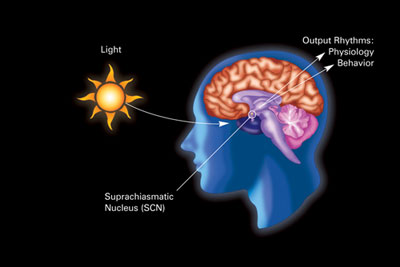
Today we looked at the two 'biological clocks' or pacemakers in the body: the SCN and the pineal gland. We looked at evidence that the SCN controls circadian rhythms (mostly from animal studies which we then evaluated), and also evidence that the pineal gland and melatonin play a role in regulating drowsiness/wakefulness.
Here is the first powerpoint on the SCN.

Here is the second powerpoint on the pineal gland.

DON'T FORGET that next week (Tues P2 next week) we have a timed essay in class, under exam conditions. The title of the essay will be 'Discuss the role of endogenous pacemakers and exogenous zeitgebers'. 

WARNING: I'd forgotten that we hadn't covered exogenous zeitgebers. We will do this during P1 and do the essay during P2. Apologies for the mix up.

Here is a copy of the essay plan. 

Tuesday, 16 September 2014

Ultradian rhythms

Today we looked at Ultradian rhythms - those that last over 24 hours. We looked at the stages of sleep;


In a normal night there are around 4 or 5 cycles of these sleep stages.

Here is a fascinating article by Jim Horne, one of the foremost sleep researchers, which summarises lots of current research into sleep.

We briefly discussed our natural sleep cycles, and whether they have always been like that. Here is a link to a TED talk (filmed in Oxford in 2010), where the speaker discusses what happens when our sleep/wake cycles are allowed to free-run. It's really easy to listen to and understand.

Here is today's powerpoint. 

Wednesday, 10 September 2014

Infradian rhythms


Today we discussed infradian rhyhms - those that last more than 24 hours. We spent a long time looking at the menstrual cycle in all of it's glory. The details of what the menstrual cycle involves are AO1 - you don't need much of this, just a brief summary.
We discussed different ways to write evaluative material on the menstrual cycle. One is implications - we talked about PMT. Another way is to look at supporting research - we discussed Russell et al's (1980) study into synchronisation. We then used the evolutionary approach to produce even more evaluation.

Here is today's powerpoint. 

Monday, 8 September 2014

Circadian rhythms

Today we introduced our first unit 3 topic: Biological Rhythms & Sleep. We discussed biological rhythms and defined circadian rhythms as those that last around 24 hours.

Can people cope with total isolation in a confined space? What would our sleep cycles be like without the sun? Michael Siffre (below) is a French geologist who has performed many temporal isolation studies - those that remove time cues - to investigate these questions.


Here is an interesting interview with him from 2008 - fascinating reading.

I handed out research booklets today; here is a copy. They don't look very exciting but will be immensely helpful in preparing for the exam and in writing essays. Examiners want to know that you can engage with research and it is my plan that these will help. BRING YOURS TO EVERY LESSON.

Here is today's powerpoint on circadian rhythms.

Keep checking this blog after lessons.

Mrs Watson