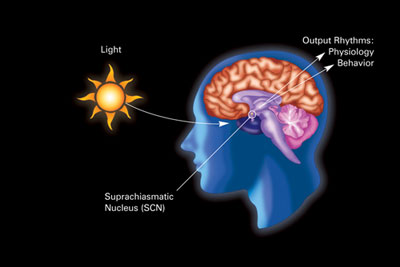
Today we looked at the external factors that can affect biological rhythms - exogenous (external) zeitgebers (time-givers). We discussed three examples; temperature, light and social cues.
Temperature affects some non-human examples of infradian rhythms such as leaf-drop from deciduous trees, migration and hibernation.
Social cues affect our mealtimes, bedtimes and lots of other behaviour. Kate Aldcroft and Michel Siffre are interesting because they excluded social cues as well as more obvious timegivers such as natural light. The Russell et al study into synchronisation of menstrual cycles shows how social cues can affect a human infradian rhythm.
Light is of course the main zeitgeber. Miles et al (1977) discussed the problems encountered by a man blind from birth.
I briefly mentioned an intriguing study from the 1980s that seemed to find that bright light shone behind the knees can affect sleep/wake cycles. Here is a discussion of the original study, and here is one that claims to debunk it. Make your own mind up......
Here is today's powerpoint.
DON'T FORGET to prepare for tomorrow's timed essay on endogenous pacemakers and exogenous zeitgebers.

No comments:
Post a Comment