Wednesday, 17 December 2014

Psychological explanations of Anorexia cont.

Today we finished off the sociocultural explanations (ppt here) with a look at Keels & Klump (2003); a big study into whether or not AN is culture-bound (and therefore essentially nurture and not nature). It is a fascinating study and the link to the original article is here - we just read the abstract. K&K found that AN isn't culturally bound and that there are many historical examples. Interestingly, Bulimia does seem to be culturally bound.

We then looked at a few psychodynamic explanations of AN. These are high in face validity but difficult to prove experimentally. The therapy that results from them has been very successful, however, so they are definitely of value. The ppt is here

The real reason for why someone ends up suffering from AN is likely to be a complex mix of genetic predisposition (possibly affecting neurotransmitter levels), possibly some cultural influences although these are by no means necessary, and possibly some disordered family background.

Happy Christmas!

Tuesday, 16 December 2014

Psychological explanations of anorexia


Today we did the timed essay in the first lesson - Sarah, Heaven, Francesca & Jack C-J please get this done in your own time and hand it in to me (30 mins without books or notes).

We started to look at sociocultural explanations of anorexia, as part of the psychological explanations. If AN is a purely biological disorder, then we would expect to see cases throughout history and across different cultures. This is largely, but not wholly, what we do see. The real picture is that it is a complicated mix of nature and nurture - media pictures of thinness probably aren't enough on their own to cause AN, but some people do seem more susceptible to them than others.

Today's ppt is here (we will finish it tomorrow morning). Tomorrow we will study psychodynamic explanations of AN.

Wednesday, 10 December 2014

TIMED ESSAY


I've rearranged things slightly to account for the low attendance seen today..........Here is the plan for next week:

Tuesday 16th  P1 - TIMED ESSAY - SEE BELOW
Tuesday P2 - Psychological explanations for AN - Sociocultural explanations
Wednesday 17th  P3 - Psychological explanations for AN - Psychodynamic explanations
Wednesday P4 - some festive quiz or similar

TIMED ESSAY: ' Discuss explanations of one eating disorder (8+16)'. No books or notes. No excuses.

Today we spruced up the back wall of R23 so no new content.
To

Tuesday, 9 December 2014

Neural explanations of AN

Today we evaluated the genetic explanations of AN - we used the ladders tool, which is just a way of structuring evaluative material to gain the most AO2 marks.

We also studied a neural explanation - that too little serotonin is the cause of Anorexia. We evaluated this. Today's ppt is here.

Wednesday, 3 December 2014

Biological theories for Anorexia Nervosa

Today we evaluated the AFFH (adapted to flee famine hypothesis) that we discussed yesterday. there is plenty of AO2 evaluative material here so do make sure you evaluate fully. Lots of the criticisms that we discussed when we looked at evolutionary explanations for eating behaviour are relevant here also. The powerpoint on AFFH is here.

We also briefly dicussed genetic explanations. Concordance rates are around 55% for MZ twins, showing a genetic influence, but there must be other factors involved. The ppt is here.

Tuesday, 2 December 2014

Anorexia Nervosa

Today we started to look at Anorexia Nervosa (AN). We defined the clinical characteristics (symptoms) in DSM-IV, and then performed a content analysis on some first-hand experiences of eating disorders. The first powerpoint is here.


We then started to look at biological explanations for AN, and looked at the evolutionary explanation, proposed by Guisinger (2003). This is very interesting and fairly contentious. The ppt is here, and we will continue this tomorrow.

Here is the NHS site which contains loads of helpful information; the videos we watched in class came from here.

Here is the BEAT website, which provides helplines, online support and a network of self-help groups, plus masses of useful information. This is the best place to look for support online if you or a friend are suffering from an eating disorder. 

Wednesday, 26 November 2014

Evolutionary explanations for eating behaviour part 2

Today we looked at the burger evaluation tool - I think this will be really useful to you in essay writing. It is a way of structuring research evidence to support or undermine a theory/explanation. We did two examples in class and then started an essay - the title was ' Outline and evaluate evolutionary explanations of food preferences' (8+16). The essay plan is here. This needs to be completed for homework.

Tuesday, 25 November 2014

Evolutionary explanations of eating behaviour


Today we discussed the EEA (environment of evolutionary adaptiveness) - the environment in which many of our current behaviours were adaptive. They are no longer adaptive because the environment has changed. This is highly relevant to food preferences today - a diet rich in sugars and fats is extremely maladaptive today, but these nutrients were in short supply in the EEA so were favoured.

Today's powerpoint is here.

Make sure you hand in your essay on dieting behaviour tomorrow.

Wednesday, 19 November 2014

Neural mechanisms underlying eating behaviour


Today we studied the biological approach to eating behaviour - we looked at neural mechanisms that underly eating behaviour and why this is all rather reductionist. We looked at the hormones ghrelin and leptin as well. This is an area heavily supported by animal research - this can be a problem for obvious reasons, and we saw this in the case of leptin which was initially hailed as a miracle cure for obesity.

Today's powerpoint is here.

The worksheet to fill in is here.

Tuesday, 18 November 2014

The success/failure of dieting.


Today we discussed why diets don't work. We looked at one study (Herman & Mack) in lots of detail - this is one example of a topic where one study will be fine in an essay, as long as you get the most out of it and evaluate it fully. We discussed the boundary model of dieting, and the physiological and cognitive boundaries that we set in place when eating. Restrained eaters (dieters) sometimes overstep the cognitive boundary and then disinhibition (the 'what the hell' effect) sets in

Today's powerpoint is here. The TED talk that we heard today is here.

The next essay is due in on Wednesday 26th November. The title is:

'Discuss explanations for the success and/or failure of dieting (8+16).

Wednesday, 12 November 2014

A dose of research methods


Today I took some time out from Eating Behaviour to focus on some key terms from research methods. We looked at hypotheses, variables, reliability and validity. These are fairly tedious to study in themselves, but are all really useful ways of evaluating research  - plus there is a RM component to the unit 4 exam.

The powerpoint on reliability is here and the writing frame is here.

The powerpoint on validity is here and the writing frame is here.

Tuesday, 11 November 2014

Factors which influence eating behaviour

 
Today was in three sections - we looked at how 1) social learning theory, 2) peers and 3) mood can influence our attitudes to food and eating behaviour. Here is the sheet I asked you to fill in on social learning theory.
 
Here is the social learning theory ppt (short as mostly on the sheet) - use your eating behaviour booklets to fill the sheet in.
 
Here is the ppt on culture.
 
Here is the ppt on mood.
 
All the theory is contained in your eating behaviour booklets so please bring these in to every lesson.
 
I have had a request for a lesson or two on research methods as some of the concepts are a bit sketchy, so watch out for this soon.


Tuesday, 4 November 2014

Various - Tuesday 4th November

 A few points:


  • Some of you have still to hand in the half-term homework (essay on sleep disorders, link here if you need it) - please do so asap.
  • Today we reflected on our restoration theory essays, marked a sample essay and finished off the last little bit on sleepwalking (ppt here)
  • We started the Eating Behaviour topic and I handed out booklets. Groups brainstormed different factors that affect our attitudes to food and eating behaviour.
  • I am not in school tomorrow, Wednesday 5th November. Your work for the lesson is to:

1. Make notes on what social learning theory is
2. Make notes on how social learning influences attitudes to food and eating.


  • This needs to be done by next Tuesday 11th November.
  • There is no revision session during registration tomorrow.

Narcolepsy & Sleepwalking

Apologies for the late post. Here is the powerpoint on sleepwalking and insomnia that we covered on Wednesday 23rd October.

Tuesday, 21 October 2014

Insomnia


Today we looked at explanations for insomnia. We discussed whether it is helpful or not to use the primary/secondary insomnia distinction - Ohayon & Roth's study suggests that it might be best to always treat the insomnia first, whether or not it is a symptom of something else. We discussed precipitating/perpetuating/predisposing factors, and also the diathesis-stress model - more of this tomorrow. 

Today's powerpoint is here.

Tomorrow we have our timed essay on the restoration theory, and also the last bit of the sleep topic.


Wednesday, 15 October 2014

Lifespan changes in sleep


We looked today at how sleep changes over the human lifespan. You drew timelines and then we discussed the evaluative material for each stage. This is a straighforward topic that gathers together material we have already studied. Today's powerpoint is here


Our next timed essay is next Wednesday, 22nd October, period 3. The title is:

 Outline and evaluate restoration theory as an explanation of the function of sleep
(8+16 marks)

A suggested plan is here.

Tuesday, 14 October 2014

Restoration theories of sleep

Today we looked at the second theory of sleep - the restoration theory - which suggests that sleep is for our body to restore itself after the day's activities. Oswald is the main proponent and he suggested that REM was for brain restoration and SWS is for bodily restoration. We looked at the evidence for this, and concluded that the REM/brain restoration link was better supported.

We looked at two sleep deprivation case studies, to see whether the lack of sleep could provide clues as to it's purpose. There is plenty of information on Peter Tripp and Randy Gardener out there; here is a sample about Randy Gardener.

Today's powerpoint is here.

Your next timed essay will be on the restoration theory of sleep. This will be on Wednesday 22nd October.

Mrs Watson


Wednesday, 8 October 2014

Evolutionary explanations of sleep continued...


Today we looked at the second evolutionary explanation - energy conservation. Sleep is constrained by predator risk, and research found that prey animals sleep less than predators, presumably for this reason. This reason isn't wholly satisfactory for various reasons - we discussed the fact that evolutionary arguments are non-falsifiable, and in this case can be used to prove entirely contradictory behaviour (eg you could argue that staying asleep is a good way to avoid predators).
The powerpoint is the same as yesterdays, on the previous blog post.
Don't forget to bring your sleep diaries in next Tuesday (21st).

Tuesday, 7 October 2014

Evolutionary theories of sleep


Today we looked at the first evolutionary theory of sleep - that of energy conservation. This says that sleep is for energy conservation, but there are various problems with the theory and we spent a long time discussing these. It's probably the case that sleep evolved for a variety of reasons, that differ across species, and no-one theory will satisfactorily answer the question of why we sleep.

The key studies supporting this study (Zeppelin & Rechtschaffen, and Allison & Cicchetti) are correlational only - so very difficult to prove cause and effect.

The powerpoint on evolutionary theories of sleep is here - we haven't finished it all yet - there is more to come!


Wednesday, 1 October 2014

The nature of sleep


Today we looked at the nature of sleep and it's normal characteristics, both in humans and animals. This is pretty straightforward stuff and the powerpoint is here

We also spent some time looking at our essays and how to improve them for next time. The next timed essay will be on Tues 7th Oct, on shift work and jet lag, and I handed out plans today. A copy is here. Don't forget my comments on improving AO2 and cutting down on unnecessary AO1 detail.  

Tuesday, 30 September 2014

Shift work and jet lag


Today we looked at what happens when our biological rhythms are disrupted - through shift work (working nights) and jet-lag.

There are many unpleasant side-effects associated with shift work and jet lag, and them main reason behind this is that we are simply not adapted to working at night or crossing time-zones very quickly.

Here is an interesting article advising doctors on how to manage working nights.

Here is the shift work powerpoint.

Here is the jet-lag powerpoing.

Please sort your folders in advance of tomorrow's folder check.

Tuesday, 23 September 2014

Exogenous zeitgebers


Today we looked at the external factors that can affect biological rhythms - exogenous (external) zeitgebers (time-givers).  We discussed three examples; temperature, light and social cues.

Temperature affects some non-human examples of infradian rhythms such as leaf-drop from deciduous trees, migration and hibernation.

Social cues affect our mealtimes, bedtimes and lots of other behaviour. Kate Aldcroft and Michel Siffre are interesting because they excluded social cues as well as more obvious timegivers such as natural light. The Russell et al study into synchronisation of menstrual cycles shows how social cues can affect a human infradian rhythm.

Light is of course the main zeitgeber. Miles et al (1977) discussed the problems encountered by a man blind from birth.

I briefly mentioned an intriguing study from the 1980s that seemed to find that bright light shone behind the knees can affect sleep/wake cycles. Here is a discussion of the original study, and here is one that claims to debunk it. Make your own mind up......

Here is today's powerpoint.

DON'T FORGET to prepare for tomorrow's timed essay on endogenous pacemakers and exogenous zeitgebers. 

Wednesday, 17 September 2014

Endogenous pacemakers

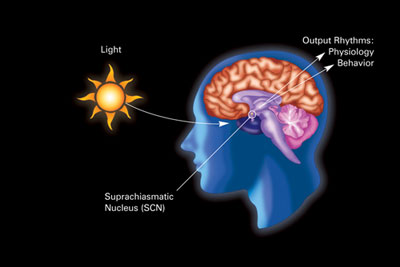
Today we looked at the two 'biological clocks' or pacemakers in the body: the SCN and the pineal gland. We looked at evidence that the SCN controls circadian rhythms (mostly from animal studies which we then evaluated), and also evidence that the pineal gland and melatonin play a role in regulating drowsiness/wakefulness.
Here is the first powerpoint on the SCN.

Here is the second powerpoint on the pineal gland.

DON'T FORGET that next week (Tues P2 next week) we have a timed essay in class, under exam conditions. The title of the essay will be 'Discuss the role of endogenous pacemakers and exogenous zeitgebers'. 

WARNING: I'd forgotten that we hadn't covered exogenous zeitgebers. We will do this during P1 and do the essay during P2. Apologies for the mix up.

Here is a copy of the essay plan. 

Tuesday, 16 September 2014

Ultradian rhythms

Today we looked at Ultradian rhythms - those that last over 24 hours. We looked at the stages of sleep;


In a normal night there are around 4 or 5 cycles of these sleep stages.

Here is a fascinating article by Jim Horne, one of the foremost sleep researchers, which summarises lots of current research into sleep.

We briefly discussed our natural sleep cycles, and whether they have always been like that. Here is a link to a TED talk (filmed in Oxford in 2010), where the speaker discusses what happens when our sleep/wake cycles are allowed to free-run. It's really easy to listen to and understand.

Here is today's powerpoint. 

Wednesday, 10 September 2014

Infradian rhythms


Today we discussed infradian rhyhms - those that last more than 24 hours. We spent a long time looking at the menstrual cycle in all of it's glory. The details of what the menstrual cycle involves are AO1 - you don't need much of this, just a brief summary.
We discussed different ways to write evaluative material on the menstrual cycle. One is implications - we talked about PMT. Another way is to look at supporting research - we discussed Russell et al's (1980) study into synchronisation. We then used the evolutionary approach to produce even more evaluation.

Here is today's powerpoint. 

Monday, 8 September 2014

Circadian rhythms

Today we introduced our first unit 3 topic: Biological Rhythms & Sleep. We discussed biological rhythms and defined circadian rhythms as those that last around 24 hours.

Can people cope with total isolation in a confined space? What would our sleep cycles be like without the sun? Michael Siffre (below) is a French geologist who has performed many temporal isolation studies - those that remove time cues - to investigate these questions.


Here is an interesting interview with him from 2008 - fascinating reading.

I handed out research booklets today; here is a copy. They don't look very exciting but will be immensely helpful in preparing for the exam and in writing essays. Examiners want to know that you can engage with research and it is my plan that these will help. BRING YOURS TO EVERY LESSON.

Here is today's powerpoint on circadian rhythms.

Keep checking this blog after lessons.

Mrs Watson